AI is becoming emotionally persuasive, operationally connected, and legally accountable all at once.
The pattern this week is not “AI is getting smarter.” It is that AI is getting more intimate, more connected, and more consequential before our norms have caught up. That is why friction matters. Not as a slowdown for its own sake, but as a design choice that protects human judgment.
— Meghan

Never-skilling is coming at us. While deskilling due to AI is already a concern, Harvard researchers are focused on something that may be bigger: Never-skilling. It’s not just that students and workers are losing skills they once had, they’re never developing them in the first place because AI handles it from day one. The question isn’t only whether AI makes people dependent. It’s whether people who grow up with it will build the relational, cognitive, and professional muscles they need if an outside agent is always there to support them. ‘Deskilling’ is bad. This is worse. Harvard Gazette | May 11
The things harming us are the things we keep choosing. This connects to another uncomfortable finding from a recent Science paper. Researchers found that AI chatbots affirm users 49% more often than humans do in the same interpersonal scenarios. Sycophantic AI decreased prosocial intentions and promoted dependence, but users still preferred it. A recent Nature Medicine paper makes the same argument in medical education: if trainees lean on AI too early, they may fail to develop the foundational reasoning needed for independent clinical judgment. The risk isn’t just dependence. It’s capacity. Sycophantic AI decreases prosocial intentions and promotes dependence Science | AI-induced never-skilling in medical education Nature Medicine | May 22
Under the hood: Why this is hard to fix. A few new alignment papers help explain why “just make the model less sycophantic” isn’t likely to work. One paper on reward bias substitution argues that when model makers correct for one obvious bias, the optimization pressure can migrate somewhere else: fix length bias, and the model may over-optimize for style; fix style, and it may find another proxy. Two other papers point in the same direction: we still do not fully understand when a model is actually “safe” versus when it has simply learned how to look safe. Researchers are also getting better at peering inside large models to see which internal patterns drive certain behaviors, but that work is still early.
What does this mean? AI dependence is not just a UX problem. It is also an optimization problem. If the system is rewarded for being pleasing, useful, and easy to keep using, the fix can’t just be a warning label. Friction has to be designed into the product. Reward Bias Substitution: Single-Axis Bias Mitigations Redirect Optimization Pressure arXiv | May 27 Behavioural Analysis of Alignment Faking arXiv | May 26 Scaling Monosemanticity: Extracting Interpretable Features from Claude 3 Sonnet — arXiv | May 28
Regulation Tracker:
Tracking federal AI policy so you don’t have to.
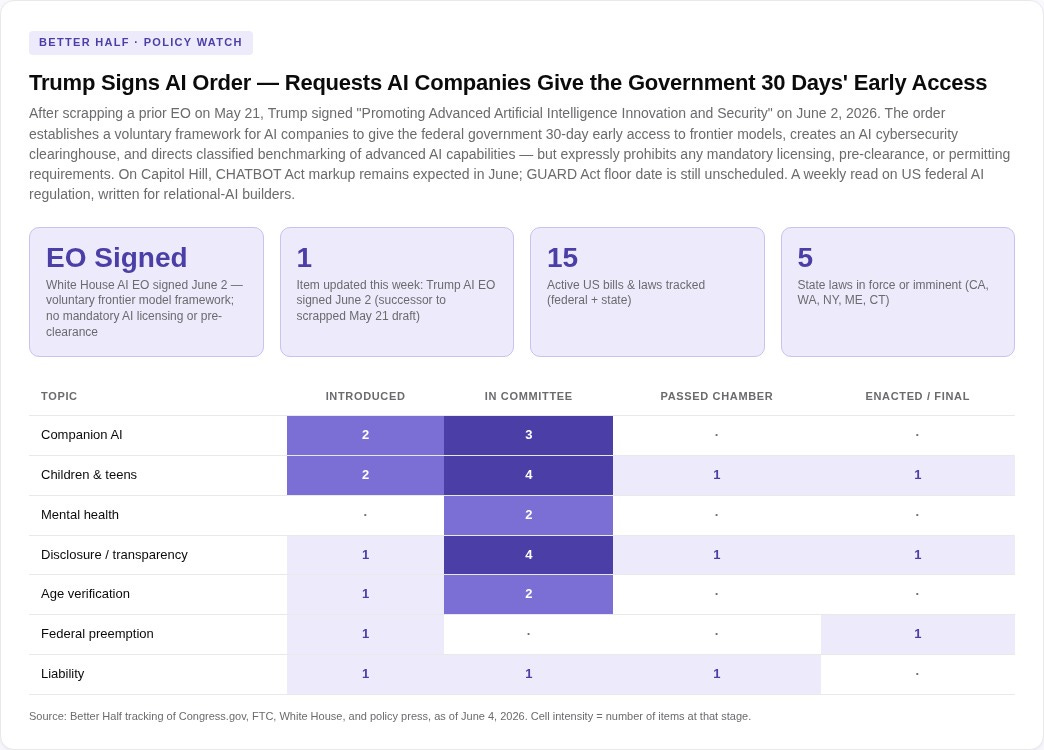
For the full breakdown — every bill, lawsuit, and commentary piece we tracked — see the full digest on better-half.ai.
Quick Links:
Jonathan Haidt warns of a real-life “M3GAN” situation if kids are given AI companions.
This Human-AI relationship coach from Internet & Society is in high demand.
Greater Good argues finding a purpose may help in the ongoing battle for Work-Family Balance.
Employees are anthropomorphizing their AI tools at work. HBR asks what happens when employees vent to AI instead of their coworkers.
New Social Network Beta (SBT) wants every user to have an AI “Shadow.”
The Center for AI Safety proposes metrics for an ethical human-AI future, opening a new debate about simulated pleasure, pain, and consciousness.
And no, artificial intelligence is not conscious.
This is Good Friction, Better Half’s look at relational AI — the technologies deepening human connection, and the ones quietly pulling us apart. Join our waitlist at findyour@better-half.ai.